We may earn a commission when you click links to retailers and purchase goods. More info.
We’re a solid month into our time with the Pixel 6 and Pixel 6 Pro. With that said, it’s never a bad thing to look ahead, especially since work goes into future devices long before they are ever announced. Taking this into consideration, we’d like to present you with our wishlist for the presumably upcoming Pixel 7 and Pixel 7 Pro, devices we don’t expect to see until October, 2022. Will we all even be alive by then? Who knows, but our fingers are crossed.
We have a few complaints with the Pixel 6 lineup, but it’s not a long list at all. We’d like to see Google address these issues with its next devices. There are three main points: Biometric security (aka the fingerprint reader), charging speeds, and the size. Seriously, we’re not asking for a lot. All we want is a faster way to unlock our phone or a return to the rear-facing Pixel Imprint, faster charging speeds, plus a smaller size option. That’s it, nothing crazy!
Are we missing something? Headphone jack? SD card slot? Just kidding, those things are never coming back.
Check out the video below. It’s another quickie and won’t take up much of your time at all.
The Google Pixel 7 could – along with the iPhone 14 – be one of the most exciting phones of late 2022. Yes, late 2022 – so it’s a way off yet, but the first leaks are already starting to appear, and it’s never too early to start thinking about what we want from Google’s next flagship.
That’s what you’ll find in this article – a wish list containing the main features and upgrades that we want the Pixel 7 (and Pixel 7 Pro) to offer, in order to make them the best phones possible.
But that’s not all, before that you’ll find everything that we’ve heard about the Google Pixel 7 range so far, including information on its release date, price and specs.
We’ll also be adding to this article whenever we hear anything new – but expect the Google Pixel 6a and maybe even a Google Pixel Fold before this – so keep this page bookmarked.
Google Pixel 7: cut to the chase
What is it? The next Pixel flagship
When is it out? Probably October 2022
How much will it cost? Expect a high-end price, but maybe less than rivals
Google Pixel 7 release date and price
The Google Pixel 7 will probably be announced sometime in October 2022. There aren’t any rumors saying that, but every previous model was unveiled in October of their release year, except the Google Pixel 5, which was announced on September 30 – so virtually October.
Whenever the Pixel 7 range is announced, it’s likely to go on sale a week or two later based on past form – but also probably before the end of October 2022.
As for the price, it might well fall roughly in line with the Pixel 6 range. The standard model of that starts at $599 / £599 / AU$999, while the Pixel 6 Pro starts at $899 / £849 / AU$1,299.
News and leaks
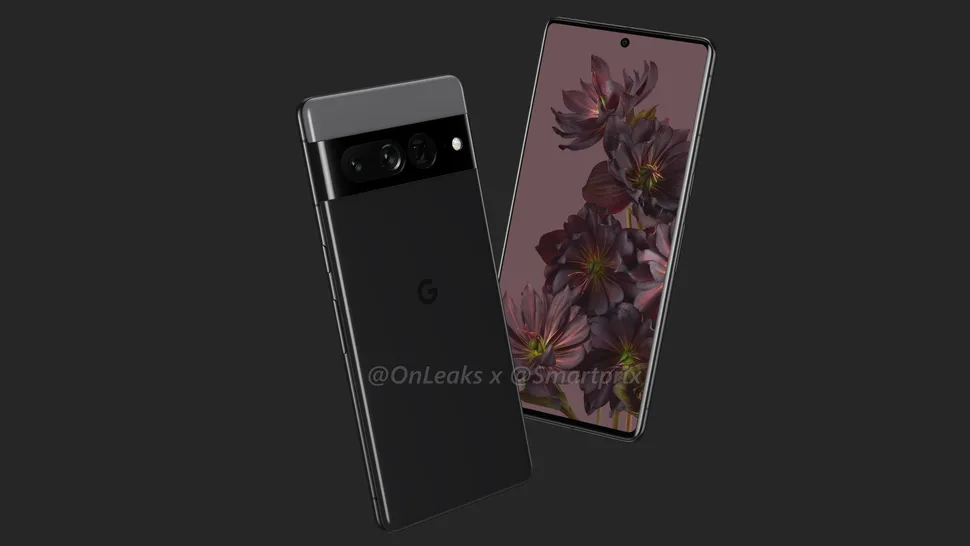
We’ve already heard a few things about the Google Pixel 7, in fact, we’ve even seen unofficial renders showing both it and the Pixel 7 Pro.
You can see some of these below, but the phones look remarkably similar to the Pixel 6 range here, with the main difference being that the camera block merges into the side of the phone here.
Image 1 of 3
An unofficial render of the Google Pixel 7 Pro (Image credit: OnLeaks / Smartprix)
An unofficial render of the Google Pixel 7 Pro (Image credit: OnLeaks / Smartprix)
An unofficial render of the Google Pixel 7 (Image credit: @OnLeaks / Carhp)
These renders also come with some details, including that the Pixel 7 is apparently 155.6 x 73.1 x 8.7mm, (rising to 11.44mm at the camera bump), while the Pixel 7 Pro is 163 x 76.6 x 8.7mm (or 11.2mm at the camera bump).
Their screen sizes could be similar to the Pixel 6 range, with the Pixel 7 said to have a 6.2-6.4-inch display, while the Pixel 7 Pro might have a 6.7 or 6.8-inch one. Cameras meanwhile could include a main, ultra-wide and telephoto on the Pixel 7 Pro, while the standard Pixel 7 might get a 50MP main, a 50MP ultra-wide, and an 8MP front-facing camera, along with a battery of around 5,000mAh.
Finally, there could be a choice of 128GB, 256GB or 512GB of storage in the standard Pixel 7, and color choices of black, coral, blue or white.
Elsewhere we’ve seen other leaked Pixel 7 Pro renders, which look similar albeit in very different colors, as you can see below.
Image 1 of 2
(Image credit: Fast Technology)
(Image credit: Fast Technology)
(Image credit: Fast Technology)
(Image credit: Fast TechnologyAnother source meanwhile suggests the screen sizes could be 6.3 inches and 6.7 inches for the Pixel 7 and Pixel 7 Pro respectively. The former would therefore be slightly smaller than the 6.4-inch Pixel 6.
We’ve also heard that the Pixel 7 range might unsurprisingly be powered by the second generation of the Google Tensor chipset, which we’ll call the Tensor 2 for convenience
Evidence of that has been found in Android code, as has mention of ‘Cloudripper’, which is believed to be a baseboard or developer board that the Pixel 7 might use.
More rumors have pointed to these Tensor 2-powered phones getting the codenames Cheetah (for the Pixel 7) and Panther (for the Pixel 7 Pro).
Google also patented an under-display camera technology in August 2021, and some have speculated that it may mean its ready for the Pixel 7. That does mean it’s likely this could be one of the next-gen phones to feature an “invisible” selfie camera.
Patents don’t always get used though, so it may be that this technology is just an experiement within Google HQ. We won’t know for sure until we see an under-display camera appear on a Pixel phone.
The Google Pixel 6 (Image credit: Future). Before the Pixel 6 range even launched there was also evidence of the Pixel 7 found by XDA Developers in the Google Camera app. The upcoming phone appears to have the codename ‘pipit’, and there’s only one model mentioned, which could mean there won’t be a Pixel 7 Pro. Since then though this codename has been linked to the rumored Pixel Fold, so it might be talking about that instead.
The code in the app suggests that the Pixel 7 (or possibly the Pixel Fold) will have most of the same camera features as the Pixel 6, and that it will have an ultra-wide lens, but there’s no mention of a telephoto one. That said, the source notes that it’s too early to be sure this version of the Google Camera app actually lists Pixel 7 features, let alone that the list is complete.
What we want to see
The Pixel 6 and Pixel 6 Pro are the most exciting Google phones in years, but they’re far from perfect, so we want to see the following changes for the Pixel 7 range.
1. Better battery life
In our reviews we listed the battery life as a negative point of both the Pixel 6 and the Pixel 6 Pro. It’s not terrible, but it’s distinctly average, so it could be a lot better.
For the Pixel 7 range then we want better battery life. Google is using a custom chipset that’s supposedly been designed from the ground up for these phones, and it makes the software that they run too, so we’d think it would be well positioned to make the Pixel range power efficient.
And if it can’t manage that, then just stick a bigger battery in. Either way, we don’t want to be worrying that we might not get to the end of the day without charging.
2. More power
(Image credit: Google)
The Google Tensor chipset at the heart of the Pixel 6 is one of the most exciting aspects of the phone, as this is the first time Google has used a custom chipset rather than an off-the-shelf Qualcomm one.
Yet, while Google talked a big game about Tensor, its performance in benchmarks isn’t a match for the best rivals, like the Snapdragon 888 powering the OnePlus 9 and Samsung Galaxy S21.
Benchmarks aren’t everything of course, but we’d still like the Google Tensor 2 to exhibit more raw power, so it can directly compete with the best rival silicon.
3. Longer support.
Prior to the launch of the Pixel 6 range it was rumored that Google would offer five years of Android updates for these phones, but in practice it only promised five years of security patches, along with three years of Android updates.
While that’s at least as good as Android rivals, it’s no match for iPhones, which sometimes get even more than five years of operating system updates.
Some other companies can point to the chipsets in their phones as holding them back, as the chipset maker also ideally needs to support updates for an extended period, but with Google making its own chipset now, it doesn’t have that excuse. In fact, it doesn’t have any excuse, so we’ll be very disappointed if the Pixel 7 isn’t supported for longer.
4. A better fingerprint scanner
(Image credit: TechRadar)
The Pixel 6 range are the first Google phones to have an under-display fingerprint scanner, but we noted in our Pixel 6 Pro review that the implementation is far from perfect.
We found that it would sometimes take several attempts to unlock, presumably because it’s pickier than some phones about exactly where you place your finger. So for the Pixel 7 we want this smoothed out, so that the fingerprint scanner reliably and rapidly works.
5. A longer, variable zoom
The Google Pixel 6 doesn’t have a telephoto camera at all, and while the Pixel 6 Pro does, it only zooms to 4x.
For the Pixel 7 (or at least the Pixel 7 Pro), we want to see the zoom extended to 10x, like on the Samsung Galaxy S21 Ultra. But we don’t want just 10x zoom – we want it also to optically zoom to 2x or 3x, or ideally to even be able to optically zoom at every level up to 10x, so you have ultimate zooming flexibility.